
ITIN Video Overview
If you live, work, and pay taxes in the U.S. but don’t have a Social Security Number, ITIN loans provide a proven path to homeownership using alternative income and flexible underwriting.
What is an ITIN Loan?
These loans use flexible guidelines to help clients with non-traditional income qualify for homeownership.
Key Points:
- Enables homeownership without a Social Security Number
- Designed for non-U.S. citizens, foreign nationals, and undocumented borrowers
- Uses alternative documentation for income and credit
- Typically offered by non-QM lenders and portfolio banks
What Can you Buy?
- Single-family homes
- Condos & townhomes
- 2–4 unit properties (live in one, rent the rest)
- Investment residential properties (not owner occupied, 1 – 8 unit)
Who ITIN Loans are for?
Who This Program Helps
- First-time homebuyers without SSN
- Self-employed borrowers
- 1099 / independent contractors
- Bank Statement Loans
- P&L Loans
- Asset Based Loans
- Borrowers with limited or no traditional credit
- Borrowers declined by traditional banks
- Full Doc Loans (i.e., W2, Tax Reports)
- Investors – Debt Service Coverage Ratio (DSCR) Loans
A Real Path to Homeownership — No Hype
Typical ITIN Guidelines
| Feature | Typical Range |
|---|---|
| Loan Type | Non-QM Mortgage |
| Use | Purchase, Refinance, Cash Out |
| Occupancy | Primary, 2nd home, Investment |
| Property Type | 1-4 Units, 5 - 8 Units, Condos, Single Family |
| Min Credit Score | ~ 660+ (No Score Programs Available) |
| Max LTV | 75% - 85% (Rare occasion 90%) |
| Down Payment | 15% - 25% (Rare occasion 10%) |
| Reserve Range | 3 to 12 months |
| Loan Amount | Up to $1M to $2.5M |
| Terms | 30 Years Fixed, ARM Option |
Documentation Requirements
- Valid ITIN (letter or card)
- Government-issued photo ID (passport, etc.)
- Consistent income (1–2 years)
- Down payment & reserves
- Credit profile (or alternative history)
- Proof of income
- 12–24 months bank statements
- 1099s + YTD income
- Tax filing history with ITIN
- Tax returns + P&L (Full Doc)
- Employment Verification
ITIN Flyer
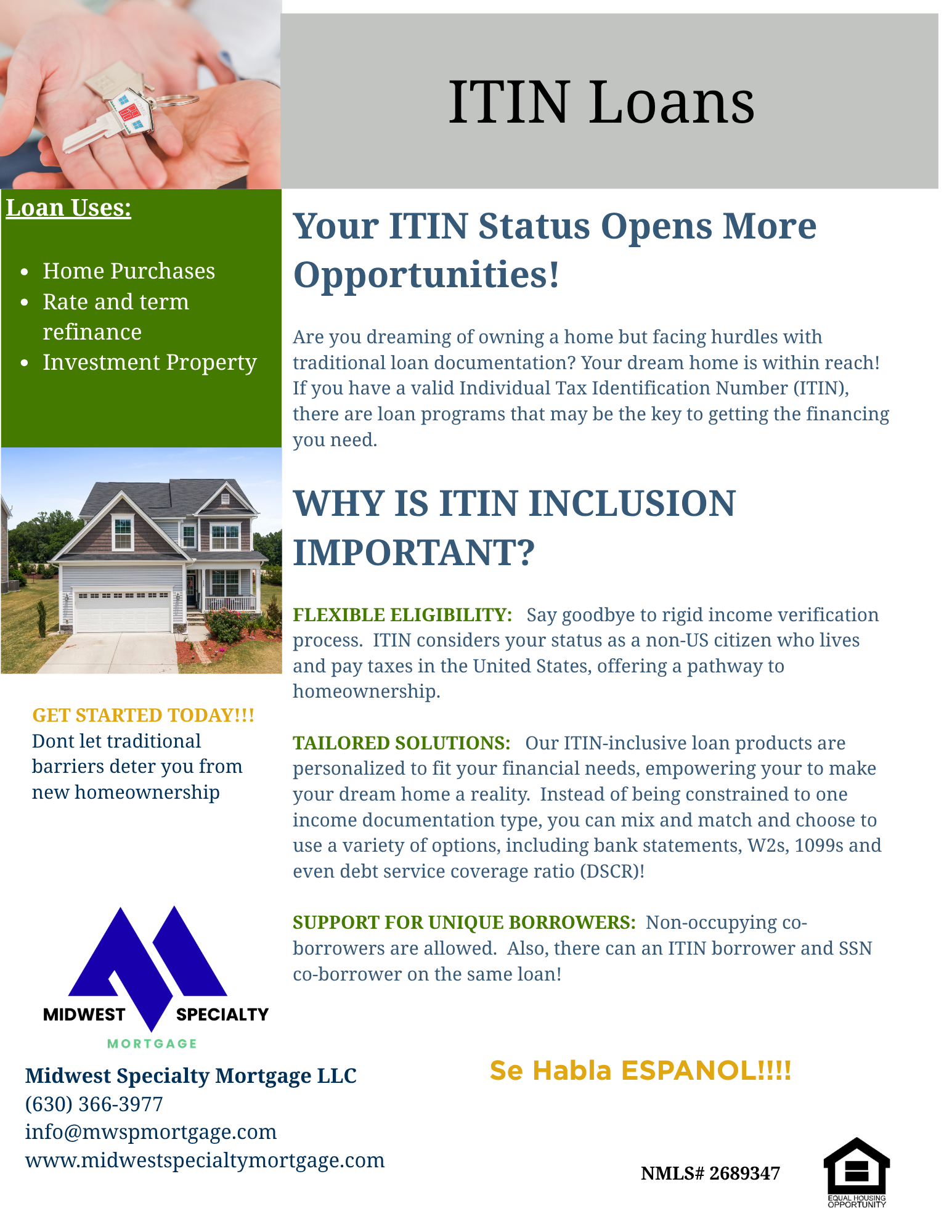
ITIN Pre-Qualification Form
Frequently Asked Questions
[vc_toggle title=”What is an ITIN loan?” color=”sky” css=””][/vc_toggle][vc_toggle title=”Can I really buy a home without a Social Security Number?” color=”sky” css=””]
[/vc_toggle][vc_toggle title=”Who qualifies for an ITIN loan?” color=”sky” css=””]ITIN loans are ideal for:
- Borrowers without a Social Security Number
- Self-employed or 1099 earners
- First-time homebuyers
- Borrowers declined by traditional banks
[/vc_toggle][vc_toggle title=”What credit score do I need?” color=”sky” css=””]
- Typical minimum: 600–660 FICO (harder to obtain)
- Better terms at 660–700+ (the norm)
- Some programs allow. – No credit score (with alternative credit)
[/vc_toggle][vc_toggle title=”How much do I need for a down payment?” color=”sky” css=””]
- Typical: 15%–25% down
- Lower down options may be available with strong credit
- Higher down may be required for:
- Lower credit
- Investment properties
[/vc_toggle][vc_toggle title=”What types of properties can I buy?” color=”sky” css=””]
- Primary residences
- Second homes (in some programs)
- Investment properties
Typical properties:
- Single-family homes
- Condos
- 2–4 unit properties (Investments)
[/vc_toggle][vc_toggle title=”Can I qualify if I’m self-employed?” color=”sky” css=””]
Yes. ITIN loans are designed for self-employed borrowers.
You can qualify using:
- Bank statements (12–24 months)
- Business bank statements
- 1099 income
- Profit & Loss statements
[/vc_toggle][vc_toggle title=”Do I need tax returns?” color=”sky” css=””]
Not always.
Options include:
- Full documentation (tax returns)
- Bank statement programs (no tax returns required)
[/vc_toggle][vc_toggle title=”What if I don’t have a traditional credit score?” color=”sky” css=””]
You may still qualify using alternative credit, such as:
- Rent payments
- Utility bills
- Phone bills
- Insurance payments
[/vc_toggle][vc_toggle title=”What documents are required?” color=”sky” css=””]
Basic requirements:
- Valid ITIN (letter or card)
- Government-issued ID (passport, etc.)
- Proof of income
Additional documents may include:
- Bank statements or tax returns
- Proof of residency
- Down payment funds
[/vc_toggle][vc_toggle title=”How long does it take to close?” color=”sky” css=””]
- Typical closing time: 2–4 weeks with non-QM lenders
- Depends on documentation and appraisal
[/vc_toggle][vc_toggle title=”Are interest rates higher?” color=”sky” css=””]
Yes, in most cases:
- ITIN loans typically have slightly higher rates than conventional loans
- Rates improve with:
- Higher credit
- Lower LTV
- Strong income
[/vc_toggle][vc_toggle title=”Why not just go to a bank?” color=”sky” css=””]
Most banks:
- Require a Social Security Number
- Have strict documentation rules
ITIN lenders:
- Accept alternative documentation
- Work with real-life income
- Offer flexible approvals
[/vc_toggle][vc_toggle title=”Can I refinance with an ITIN loan?” color=”sky” css=””]Yes. Options include:
- Rate & term refinance
- Cash-out refinance
[/vc_toggle][vc_toggle title=”What are the biggest factors for approval?” color=”sky” css=””]
- Consistent income (1–2 years)
- Tax filing history with ITIN
- Down payment
- Credit or alternative credit
- Reserves
[/vc_toggle][vc_toggle title=”What if I was denied by another lender?” color=”sky” css=””]Many ITIN borrowers are approved after being denied elsewhere because:
- Guidelines vary by lender
- Non-QM programs are more flexible
- Income can be evaluated differently
[/vc_toggle]