A rental property may look profitable, but it can be difficult to tell whether its…
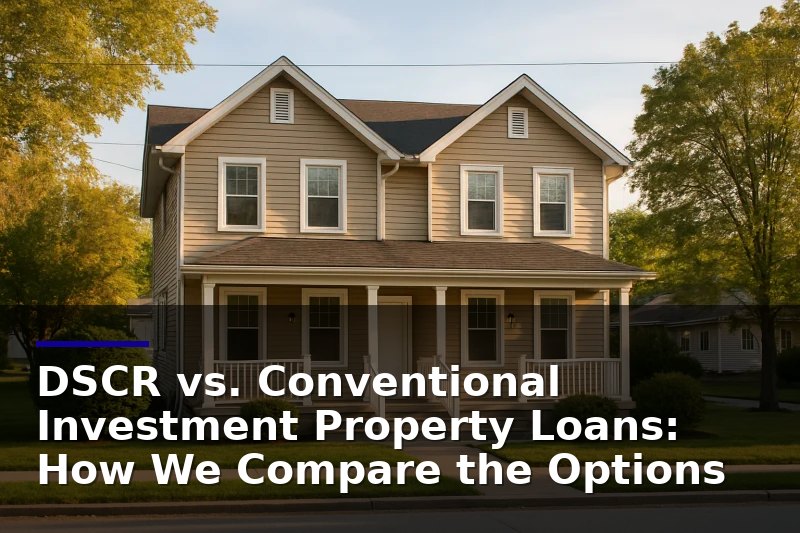
DSCR vs. Conventional Investment Property Loans: How We Compare the Options
By Eusebio Marchosky, Owner Broker | 35 years of financial services experience | Individual NMLS 2596350
Choosing between a DSCR loan and a conventional investment property loan can be difficult when both appear to finance the same rental property. A DSCR loan qualifies primarily through the property’s expected rental cash flow, while a conventional investment property loan generally relies on the borrower’s personal income, credit, debts, assets, and the property’s eligible rental income. In this guide, we at Midwest Specialty Mortgage LLC (NMLS# 2689347) explain how we compare qualification, documentation, property eligibility, costs, and long-term strategy.
Key Takeaways
- Qualification: Conventional loans evaluate the borrower’s documented income and total financial profile, while DSCR loans focus more heavily on property cash flow.
- Documentation: DSCR financing may reduce personal income documentation, but it still requires credit, asset, property, insurance, and entity documents.
- Cost: Conventional financing often has more favorable pricing for borrowers who meet agency requirements, while DSCR pricing reflects its alternative underwriting structure.
- Property Type: Both options can finance eligible residential rentals, but DSCR programs may offer more flexibility for certain investor scenarios.
- Best Fit: The right option depends on income documentation, property cash flow, ownership structure, reserves, portfolio size, and investment plans.
Quick Answers
- Do both loan types require personal tax returns? Conventional underwriting may require tax returns, especially for self-employed borrowers. Many DSCR programs do not calculate qualifying income from personal tax returns.
- Can an investor close in an LLC? Many DSCR programs permit eligible business entities, while conventional investment loans are commonly originated in an individual borrower’s name.
- Are DSCR rates usually higher? DSCR financing commonly carries different pricing than conventional financing because it uses non-agency underwriting and property-based qualification. Actual rates and costs vary by scenario.
- Which option generally fits a borrower with stable, documentable income? Conventional financing may deserve the first comparison because it can provide favorable terms when the borrower and property meet current agency guidelines.
What Is the Main Difference Between DSCR and Conventional Investment Loans?
The central difference is what underwriters use to establish repayment ability.
A conventional investment property loan generally evaluates personal income, employment or business history, credit, existing debts, liquid assets, reserves, and the proposed housing payment. Rental income may help the borrower qualify, but it is considered within a broader personal debt-to-income analysis.
A debt service coverage ratio loan takes a different approach. The lender compares qualifying property income with the property’s required debt obligations. Depending on the program, those obligations may include principal, interest, property taxes, homeowners insurance, association dues, and other applicable housing expenses.
The basic concept is:
DSCR = Qualifying monthly rental income ÷ Qualifying monthly property obligation
A stronger ratio means the property produces more qualifying rent relative to its debt obligation. Calculation methods, acceptable ratios, vacancy treatment, and qualifying rent sources vary among DSCR investors, so we verify the current program rules rather than assuming every lender calculates the ratio identically.
Readers looking for a broader program overview can review our DSCR home loan program.
DSCR vs. Conventional Investment Property Loans at a Glance
| Comparison | DSCR Loan | Conventional Investment Loan |
|---|---|---|
| Primary qualification | Property rental cash flow | Borrower income, debts, assets, credit, and eligible rental income |
| Personal income documents | Often limited or not used to calculate qualifying income | Generally required under agency and lender documentation rules |
| Debt-to-income ratio | Often not the primary qualifying test | A central part of underwriting |
| Entity ownership | LLCs and certain other entities may be permitted | Typically originated to eligible individual borrowers |
| Occupancy | Business-purpose investment property only | Eligible non-owner-occupied residential property |
| Guideline source | Individual lender and investor guidelines | Agency guidelines plus possible lender overlays |
| Typical advantage | Less dependence on personal income calculations | Potentially more favorable pricing for qualified scenarios |
This comparison is general. Guidelines, rates, fees, reserve requirements, and property standards can change, and a lender may apply requirements beyond the underlying agency or investor rules.
How We Compare the Two Options
1. We Review the Borrower’s Documentable Income
We first ask whether personal income can support a conventional loan under current underwriting rules. Salaried income may be relatively direct to document, while commissions, bonuses, rental income, partnerships, and self-employment can require additional analysis.
For a self-employed investor, taxable income may differ significantly from business cash flow because of legitimate deductions. That does not automatically mean a DSCR loan is the right answer. It means we should compare how conventional underwriting treats the income against alternatives that do not depend on the same calculation.
A bank statement program may also be worth evaluating if the borrower wants income-based qualification but tax returns do not fully represent business cash flow.
2. We Calculate the Property’s Cash Flow
For a DSCR loan, qualifying rent is a major factor. Depending on the transaction and program, the lender may consider an existing lease, a market-rent schedule from the appraisal, or a defined combination of the two.
We compare that qualifying rent with the full housing obligation used by the program. A property can generate positive cash flow in an investor’s spreadsheet yet produce a different underwriting result if the lender uses lower qualifying rent or includes expenses the investor did not include.
Market cash flow and underwriting cash flow are not always the same. Reviewing rent documentation, taxes, insurance, association dues, and proposed loan terms early can prevent surprises later.
3. We Examine Credit, Liquidity, and Reserves
DSCR does not mean documentation-free. DSCR lenders commonly evaluate credit history, down payment or equity, liquid assets, reserves, housing payment history, and significant credit events. Conventional loans evaluate many of the same factors, although the acceptable thresholds and risk analysis differ.
Reserves are especially relevant for investment properties because the owner remains responsible for the mortgage during vacancies, repairs, or tenant turnover. Some programs require more reserves based on the number of financed properties, the transaction profile, or other risk factors.
4. We Confirm Borrower and Property Eligibility Separately
A financially qualified borrower can still have an ineligible property, and an acceptable property can still be paired with an ineligible borrower profile.
Conventional agency programs have rules covering property type, condition, ownership, appraisal findings, financed-property exposure, and other factors. Lenders may add overlays that are more restrictive than the baseline agency rules.
DSCR guidelines are investor-specific. They may address short-term rentals, rural properties, condominium projects, small multifamily properties, leased properties, entity vesting, and property condition differently. A feature accepted by one DSCR investor may be restricted by another.
5. We Compare Total Cost, Not Just the Rate
Rate matters, but it is only one part of the analysis. We also review lender fees, points, prepayment provisions, mortgage insurance when applicable, appraisal requirements, closing costs, reserve needs, and the expected holding period.
DSCR loans commonly use non-agency pricing and may include a prepayment penalty where permitted. Conventional loans may offer more favorable pricing, but that advantage only helps if the borrower can meet the documentation and underwriting standards.
Rates and fees change with market conditions, credit, leverage, property type, occupancy, loan structure, and other factors. Current written estimates provide a more useful comparison than general assumptions about either program.
When a Conventional Investment Loan May Make More Sense
A conventional loan may be the stronger starting point when:
- The borrower has stable, verifiable income that supports the requested loan.
- The property meets current agency eligibility and condition standards.
- The borrower is comfortable closing in the ownership structure required by the program.
- The borrower wants to prioritize conventional pricing and terms.
- The borrower remains within applicable financed-property and exposure guidelines.
- The transaction fits conforming loan limits for the property’s county.
Conforming limits vary by county and can change. We check the current limit and applicable guidelines for each transaction rather than relying on an older figure.
When a DSCR Loan May Make More Sense
A DSCR loan may deserve closer consideration when:
- The property produces sufficient qualifying rental income.
- Personal tax-return income does not clearly represent current cash flow.
- The investor has complex self-employment, partnership, or portfolio income.
- An eligible LLC or other permitted entity is part of the ownership strategy.
- Personal debt-to-income calculations constrain conventional qualification.
- The borrower wants to keep the analysis centered on an individual property’s performance.
DSCR financing is not automatically more flexible in every category. A weak property cash-flow ratio, limited reserves, credit concerns, unusual property characteristics, or high leverage can still affect eligibility and pricing.
Example: Comparing the Same Kane County Rental
Assume an investor is purchasing a rental property in Kane County. The expected rent appears sufficient to support the proposed property payment, but the investor also owns a business and reports substantial tax deductions.
Under conventional underwriting, we would review personal income, business income, existing obligations, rental-property history, assets, and the treatment of the new property’s rent. If the resulting debt-to-income ratio meets current requirements, conventional financing may provide an attractive structure.
Under DSCR underwriting, we would focus more directly on the qualifying rent and required property obligation while still reviewing credit, assets, reserves, appraisal findings, and other program conditions. If the property’s ratio is acceptable, personal tax-return income may not control the decision.
The correct conclusion cannot be reached from the property address or rent estimate alone. We need to compare both structures using the same purchase price, down payment, taxes, insurance, rent evidence, and ownership plan.
Local Factors for Chicagoland Investment Properties
Property taxes can materially influence rental-property qualification throughout the Fox River Valley and the Northwest Suburbs of Chicago. Two similarly priced properties may have noticeably different total payments because of taxes, insurance, or association dues, which can affect both DSCR and conventional calculations.
For properties in Kane County, McHenry County, DuPage County, Cook County, and surrounding Illinois markets, we encourage investors to evaluate the complete property obligation before making financing assumptions. Our broader investment property loan options page outlines additional financing structures that may be available.
Documents We Commonly Review
The exact file depends on the program, but an early comparison may include:
- Purchase contract or current mortgage statement for a refinance
- Property address, estimated value, and expected rental income
- Current lease and rent history, if applicable
- Personal and business asset statements
- Credit authorization and housing payment history
- Income and employment documents for conventional qualification
- Business entity documents if an LLC or other eligible entity will hold title
- Estimated property taxes, insurance, and association dues
- Schedule of other owned properties and related mortgages
Providing complete information helps us make an honest side-by-side comparison. It also identifies whether the main issue is borrower eligibility, property eligibility, documentation, or program selection.
Review Your Investment Loan Scenario
We can compare conventional and DSCR financing using your actual income profile, property rent, expenses, reserves, ownership plan, and investment timeline. As of 2026, program rules remain lender- and investor-specific, so current guideline verification is part of a responsible review.
Call, text, or email us to discuss your scenario, compare available options, and understand the next steps. If you are preparing to make an offer, we can also discuss pre-approval planning and which property details should be checked before you commit.
Frequently Asked Questions
Can a vacant property qualify for a DSCR loan?
Possibly. Some DSCR programs can use market rent from an appraisal for a vacant property, while others impose additional restrictions or adjust the qualifying rent. The property’s condition, local rental market, transaction type, and specific investor guidelines all matter.
Can I occupy a property financed with a DSCR loan?
DSCR loans are generally business-purpose loans for non-owner-occupied investment properties. Borrowers typically sign an occupancy certification confirming that the property will not be used as a primary or second home. A different mortgage program should be reviewed if personal occupancy is planned.
How does the appraisal affect a DSCR calculation?
The appraisal commonly supports both the property value and market rent used in underwriting. If documented or appraised rent is lower than expected, the DSCR may decline and affect available terms. Each investor has rules for selecting the qualifying rent when a lease and market-rent estimate differ.
Can a DSCR loan be refinanced into a conventional mortgage later?
It may be possible if the borrower, property, ownership, equity, and transaction meet conventional guidelines at that time. The analysis may include documented personal income, debt-to-income ratio, title history, and refinance seasoning requirements. Any DSCR prepayment provision should also be reviewed before refinancing.
Can DSCR financing be used for mixed-use or small commercial real estate?
Standard residential DSCR programs generally focus on eligible residential investment properties. Mixed-use buildings and small commercial properties may require a separate small-balance commercial real estate program with different cash-flow, appraisal, entity, and property standards. The property’s actual use should be reviewed before selecting a program.
This is educational and not financial advice. Loan programs and guidelines can change. Talk with a licensed mortgage professional about your specific scenario.

About the Author
Eusebio Marchosky
Owner Broker at Midwest Specialty Mortgage LLC · NMLS #2596350
I’m Chevy Marchosky, Broker Owner of Midwest Specialty Mortgage. I have over 40 years in the financial services industry, I’ve had the privilege of helping shape the way lending works—from the inside out.
Specializes in: Conventional, Non-QM Loans, DSCR/SBCRE Loans
Licensed in: IL, IN, IA
Related Posts