Buying your next home before your current property sells can solve a timing problem, but…
Conventional Loan Limits for Move-Up Buyers With a Large Down Payment
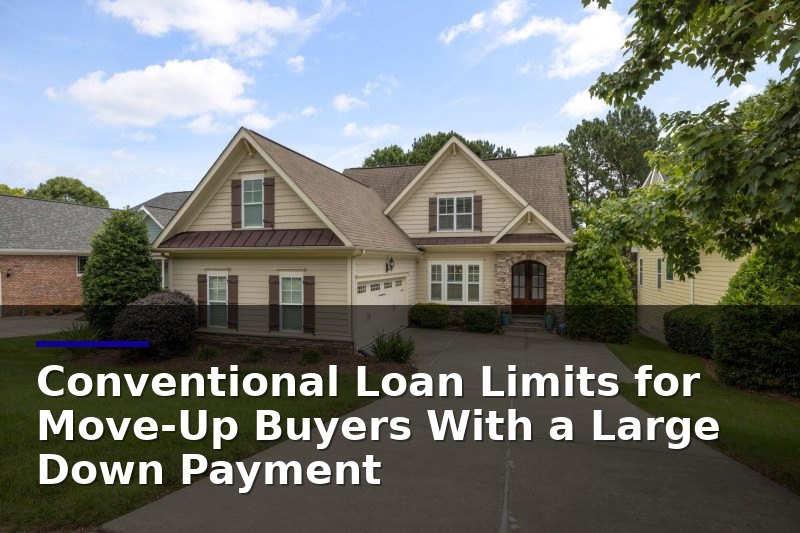
Selling one home and purchasing a more expensive property can raise questions about whether the new mortgage will exceed conventional loan limits. A conventional loan limit applies to the amount borrowed—not the purchase price—so a large down payment may keep a move-up buyer’s mortgage within the conforming limit. This guide explains how loan limits, down payments, home equity, and financing alternatives work together when planning a move-up purchase.
At Midwest Specialty Mortgage LLC (NMLS# 2689347), we help buyers in Kane County and throughout the greater Chicagoland area compare the loan amount they need with current county limits and available conventional or non-QM options.
Key Takeaways
- Loan Limit: The applicable conventional loan limit is based on the mortgage amount, not the home’s full purchase price.
- Down Payment: Equity from a current home may help reduce the new loan to a conforming amount.
- Location: Conforming loan limits can vary by county and are generally updated each year.
- Qualification: A larger down payment helps reduce the loan-to-value ratio, but income, credit, assets, debts, and property eligibility still matter.
- Alternatives: Buyers above the conforming limit may consider a jumbo loan, bridge financing, or another conventional or non-QM structure.
Quick Answers
- Does the conventional limit restrict the home price? No. It restricts the loan amount. A buyer may purchase above the limit if the down payment keeps the mortgage within it.
- Can proceeds from my current home fund the down payment? Often, yes. The lender will document the sale, payoff, closing costs, and net proceeds available for the next purchase.
- Is every conventional mortgage a conforming loan? No. Conforming loans meet Fannie Mae or Freddie Mac requirements, while jumbo and some non-QM loans are also conventional but do not conform to those agency standards.
- Does a large down payment guarantee conforming approval? No. The borrower, property, income, assets, credit profile, and overall transaction must still satisfy the applicable guidelines.
How Conventional Loan Limits Affect Move-Up Buyers
A conforming loan limit is the maximum mortgage balance that may be eligible for purchase by Fannie Mae or Freddie Mac under the applicable county and property-type guidelines. The Federal Housing Finance Agency generally updates these limits annually.
The calculation for a move-up buyer is straightforward:
Purchase price − down payment = base loan amount
If that loan amount is at or below the current limit for the county and property type, the mortgage may fit within conforming parameters. Eligibility still depends on the complete application and the applicable agency and lender requirements.
For example, consider a purely hypothetical purchase:
- Purchase price: $900,000
- Down payment from savings and sale proceeds: $250,000
- Estimated base loan amount: $650,000
The relevant figure for the loan-limit comparison is $650,000, not $900,000. We would then compare that requested mortgage with the current limit for the property’s county and number of units. This example is for explanation only and does not represent a current county limit or an approval decision.
Why a Large Down Payment Can Change the Financing Options
A substantial down payment can do more than keep a mortgage below the conforming threshold. It may also improve the overall structure of the transaction.
It reduces the loan-to-value ratio
Loan-to-value, or LTV, compares the mortgage balance with the property’s appraised value or purchase price, subject to program rules. A lower LTV generally represents more borrower equity and less lender exposure.
Depending on the transaction, a lower LTV may affect pricing, mortgage insurance, reserve requirements, and available loan programs. It does not override credit, income, debt-to-income, appraisal, or property requirements.
It may help avoid jumbo financing
A loan above the applicable conforming limit is commonly described as a jumbo loan. Jumbo guidelines are set by individual lenders and investors rather than a single universal agency standard.
Jumbo financing may require stronger reserves, different appraisal procedures, or more detailed income and asset documentation. Requirements vary considerably, so putting more money down to reach a conforming loan amount may simplify the available choices—but it is not automatically the right use of the buyer’s cash.
It may reduce or eliminate private mortgage insurance
Conventional loans with higher LTV ratios may require private mortgage insurance. A sufficiently large down payment may eliminate that requirement at closing, depending on the program.
Mortgage insurance costs vary according to factors such as credit, down payment, occupancy, loan term, and coverage level. Buyers should compare the full monthly payment and closing structure rather than focusing only on whether mortgage insurance applies.
Conforming Versus Jumbo Financing
| Feature | Conforming Conventional Loan | Jumbo Conventional Loan |
|---|---|---|
| Loan amount | Within the applicable conforming limit | Above the applicable conforming limit |
| Guideline source | Generally follows Fannie Mae or Freddie Mac standards | Follows the lender’s and investor’s specific standards |
| Documentation | Standard agency documentation and automated underwriting may apply | May involve additional asset, reserve, income, or appraisal review |
| Pricing | Based on current markets and agency-related adjustments | Varies by lender, investor, loan size, credit, reserves, and LTV |
| Best comparison method | Compare rate, payment, cash required, reserves, closing costs, and liquidity after closing | |
As of 2026, buyers should verify the current limit for the county where the new property is located. The limit is not based on where the buyer currently lives or where the existing home is being sold.
County and Property Type Matter
Conforming limits may differ between standard-limit and designated high-cost counties. Limits also vary according to the number of legal residential units in the property.
For a purchase in Kane County, McHenry County, DuPage County, Cook County, or elsewhere in the Fox River Valley and Northwest Suburbs of Chicago, we review the limit tied to the property address. A buyer selling in one Illinois county and purchasing in another should not assume the same threshold applies to both locations.
Property eligibility is separate from borrower eligibility. A borrower may have sufficient income, credit, and assets, but the property must still meet program standards concerning occupancy, condition, appraisal, title, and legal use.
How to Decide How Much Equity to Put Down
Using enough equity to obtain a conforming loan can be appealing, but the smallest mortgage is not always the only goal. Move-up buyers should consider how much liquidity they want after closing.
Review the complete cash requirement
The down payment is only one part of the funds needed. Buyers may also need cash for closing costs, prepaid taxes and insurance, moving expenses, repairs, furnishings, and required reserves.
Putting every available dollar into the home can leave limited flexibility after closing. We generally recommend comparing several structures before deciding how much equity to deploy.
Compare multiple loan amounts
A useful analysis may include:
- A conforming mortgage funded with a larger down payment
- A jumbo mortgage that preserves additional cash
- A first mortgage combined with other permitted financing
- A temporary bridge strategy when sale proceeds are not yet available
Buyers who need equity from their departing residence before it sells may want to review how a bridge home loan can support the timing of a move-up purchase. Bridge financing carries costs and repayment obligations, so it should be evaluated alongside the expected sale timeline.
Protect post-closing reserves
Reserves are funds remaining after closing that can be measured in months of housing payments. Some programs require them, while others treat reserves as a positive financial factor.
Jumbo loans, multiple financed properties, and more complex income scenarios may involve higher reserve expectations. Funds generally must be documented and held in an acceptable account or asset type under the selected program.
What If the Existing Home Has Not Sold?
The timing of the sale can affect both the down payment and qualification. If the current home will remain owned at the time of the new closing, its mortgage, taxes, insurance, association dues, and other obligations may need to be included in the debt analysis.
Possible strategies include:
- Making the new purchase contingent on selling the current home
- Closing the sale before completing the new purchase
- Using documented savings for the initial down payment and replenishing funds after the sale
- Considering bridge financing or a qualifying home equity source
- Using jumbo financing temporarily if the available down payment does not yet reduce the loan to the conforming limit
Each option has tradeoffs involving timing, interest expense, liquidity, contract strength, and qualification. Funds borrowed against another property also create a liability that generally must be considered during underwriting.
Income Documentation Still Matters With a Large Down Payment
A large down payment reduces lender risk, but it normally does not replace the need to establish the borrower’s ability to repay. Salaried borrowers may provide pay statements, W-2 forms, tax records, and asset statements. Self-employed borrowers often need business and personal documentation based on the program and ownership structure.
For borrowers whose tax returns do not fully reflect their current cash flow, a bank statement mortgage program may provide an alternative method of documenting income. These are generally non-QM loans with different pricing, down payment, reserve, and documentation standards than conforming financing.
Agency requirements and lender overlays are not always identical. Fannie Mae or Freddie Mac may permit a particular scenario, while an individual lender may apply a more restrictive rule. Conversely, a non-QM investor may accept a scenario outside agency standards but require more equity or reserves.
A Practical Pre-Approval Plan for Move-Up Buyers
- Estimate net sale proceeds. Subtract the expected mortgage payoff, liens, real estate costs, and seller closing expenses from the anticipated sale price.
- Choose a target purchase range. Consider the total monthly payment, not just the maximum purchase price.
- Calculate the likely loan amount. Subtract the planned down payment from the target price.
- Check the current county limit. Use the county of the property being purchased and confirm the correct limit for its unit count.
- Document funds and income. Gather statements for the down payment, reserves, earnings, and existing property obligations.
- Compare structures. Review conforming, jumbo home loan, bridge, and relevant non-QM alternatives.
- Plan for different sale timelines. Determine how qualification and cash needs change if the existing home sells before, after, or simultaneously with the new purchase.
Rates, fees, loan limits, underwriting standards, and program availability can change. A pre-approval should therefore be updated when the purchase price, down payment, property location, income, debts, or sale timeline changes.
Talk With Us About Your Move-Up Purchase
We can help you estimate sale proceeds, check the current county loan limit, and compare conforming, jumbo, bridge, and non-QM choices. We serve borrowers across Kane, McHenry, Kendall, Will, Cook, Lake, DuPage, DeKalb, and Grundy counties and are licensed in Illinois, Iowa, and Indiana.
Call, text, or email us to review your scenario, compare options, and understand the next steps. Early pre-approval planning can clarify how much equity to use and how the timing of your current home sale may affect the new purchase.
Eusebio Marchosky
Owner Broker
Individual NMLS: 2596350
Over 35 years of Financial Services Experience
Frequently Asked Questions
What happens if the appraisal is lower than the purchase price?
The lender generally calculates loan-to-value using the lower of the purchase price or appraised value, subject to program rules. A low appraisal may require a larger down payment, a lower loan amount, renegotiation with the seller, or a different financing structure.
Can gift funds be combined with equity from my current home?
Conventional guidelines may permit eligible gift funds, but the donor, transfer, documentation, occupancy, and minimum borrower-contribution rules depend on the transaction. The lender must also document the separate proceeds from the sale of the current home.
Can I recast the new conventional loan after my old home sells?
Some conventional loan servicers allow a borrower to make a substantial principal payment and request a recast, which recalculates the payment without a full refinance. Availability, minimum principal payments, fees, timing, and loan eligibility vary by servicer and should be confirmed before closing.
Do conforming limits change for a two-unit property?
Conforming limits are generally higher for eligible two- to four-unit properties than for one-unit homes. The property must be legally established for its unit count, and occupancy, appraisal, reserves, and rental-income rules may also apply.
Can a self-employed buyer use a conforming loan for a move-up purchase?
Yes, if the buyer meets the applicable income, credit, asset, and property requirements. Underwriting commonly evaluates the stability and continuation of qualifying income, and the documentation required depends on the business, ownership percentage, tax returns, and current agency guidelines.
This is educational and not financial advice. Loan programs and guidelines can change. Talk with a licensed mortgage professional about your specific scenario.

About the Author
Eusebio Marchosky
Owner Broker at Midwest Specialty Mortgage LLC · NMLS #2596350
I’m Chevy Marchosky, Broker Owner of Midwest Specialty Mortgage. I have over 40 years in the financial services industry, I’ve had the privilege of helping shape the way lending works—from the inside out.
Specializes in: Conventional, Non-QM Loans, DSCR/SBCRE Loans
Licensed in: IL, IN, IA
Related Posts